
Documentation / Redirect Rules After Login
Redirect Rules After Login
Overview
By default, WordPress redirects users to the admin dashboard after login. The Redirect rules after login feature lets you define custom redirect destinations based on user roles or specific users. This is useful when you want different types of users to land on different pages.
Adding a Redirect Rule
- Navigate to Settings → Custom Login.
- Open the Functionality tab.
- Expand the Redirect rules after login panel.
- Click Add new redirect rule.
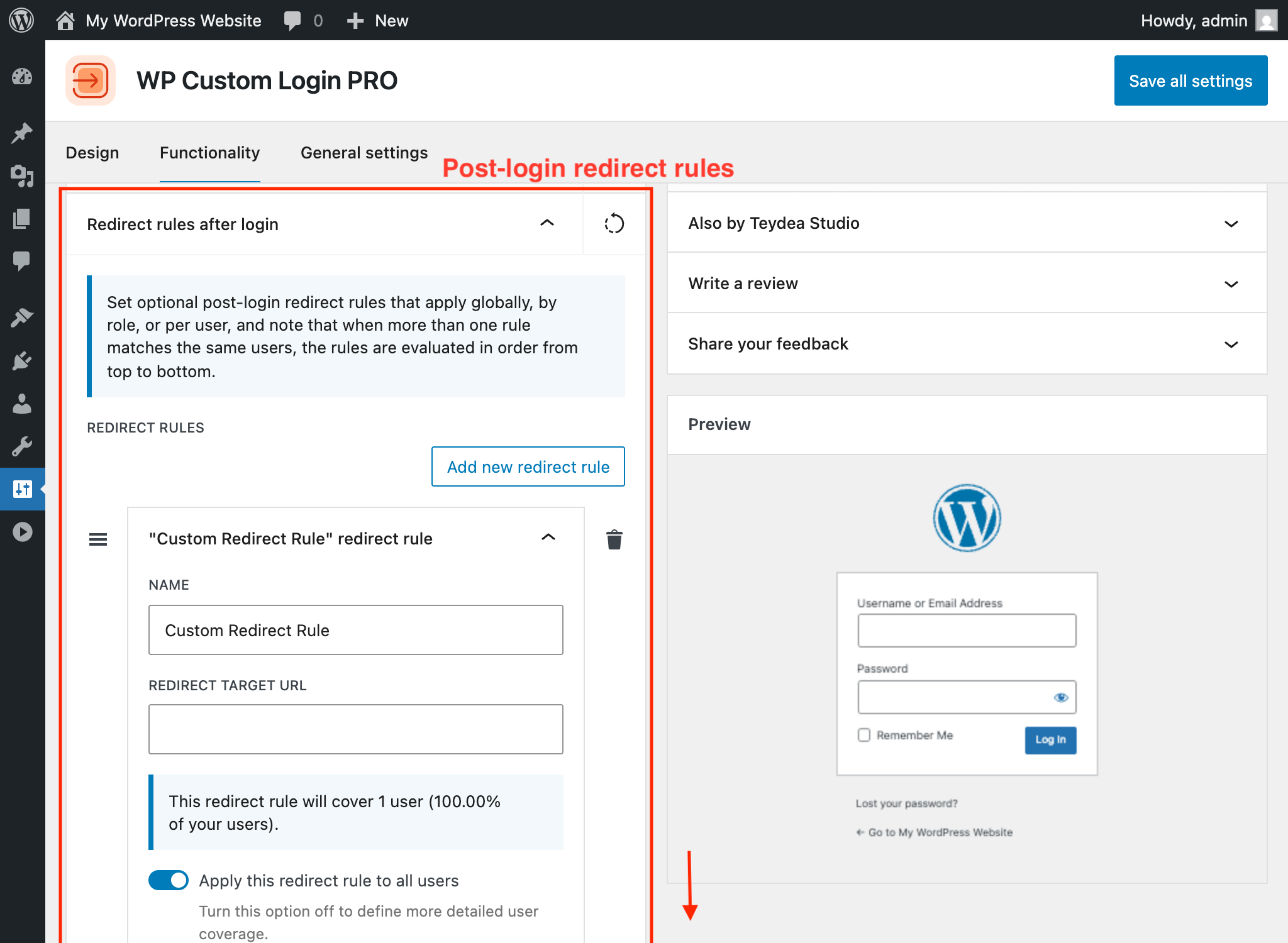
Configuring a Rule
Each redirect rule has three main settings:
Name
Give the rule a descriptive name for your own reference (for example, “Editors to Dashboard” or “Subscribers to Homepage”). This name appears in the rule’s panel heading.
Redirect Target URL
Enter the full URL where matching users should be sent after login. For example, https://yoursite.com/welcome or https://yoursite.com/wp-admin/edit.php.
User Coverage
Control which users this rule applies to:
- Apply this redirect rule to all users — When toggled on, every user who logs in matches this rule.
- Specific roles — When the “all users” toggle is off, a role selector appears. Search for and select one or more user roles (Administrator, Editor, Subscriber, etc.).
- Specific users — A user selector also appears, letting you target individual users by searching for their username.
Rule Evaluation Order
When multiple redirect rules exist, they are evaluated in order from top to bottom. The first rule that matches the logging-in user is applied. You can drag and drop rules to reorder them.
For example, if you have:
- A rule for Editors redirecting to
/editor-dashboard - A rule for all users redirecting to
/welcome
/editor-dashboard because that rule is evaluated first and matches.
Removing a Rule
To remove a redirect rule, click the delete button on the rule’s panel. Click Save all settings to confirm the removal.
FAQ
Find Answers to Common Questions
Browse these frequently asked questions to get quick answers about our plugin, features, and support.
Will This Plugin Work on My WordPress Website?
This plugin does not depend on any third-party libraries, plugins, or themes. It will work seamlessly on any WordPress website.
Does the Plugin Support My Language?
This plugin is translation-ready, enabling you to easily translate its content into your preferred language using any translation tool or plugin. By default, the plugin is provided in English.
What Are the Technical Requirements for This Plugin?
This plugin requires WordPress version 6.6 or later and PHP version 7.4 or later. It doesn’t require additional libraries or special hosting configurations.
The plugin has been tested up to WordPress 6.9 and PHP 8.3.
What Is Your Refund Policy?
We offer a risk-free, 30-day money-back guarantee. If you’re not satisfied with the plugin for any reason, you can request a full refund within 30 days of your purchase – no questions asked.
Is This Plugin Actively Maintained?
Yes! This plugin is actively maintained and regularly tested for compatibility with the latest versions of WordPress and PHP. For detailed information about updates, please refer to the changelog.
What Happens If I Don’t Renew My License?
You can continue to use the plugin even if your license expires; however, you will no longer receive plugin updates, new features, or access to support. Your license renews automatically each year unless canceled via the Customer Portal.
What Is the Difference Between the Free and PRO Versions?
The free version gives you full control over the login page’s visual design — custom logo, background color and image, form container styling, label and input field customization, primary and secondary button design, checkbox styling, notice and error message colors, under-form link styling, social media icons, custom footer, privacy policy link, language switcher controls, per-language text, and a custom CSS editor. You also get functionality options like disabling autofocus, the error shake animation, and browser autocomplete. Everything is configured from a visual settings page with a live preview.
The PRO version adds 20+ pre-designed templates you can apply in one click, advanced background options (multi-column split-screen layouts, image and video sliders, animated gradients, CSS image filters and color overlays), post-login redirect rules with per-role and per-user targeting, the ability to replace wp-login.php with a custom login URL, and priority support with automatic updates. See the pricing page for details.